
In the modern media landscape, interlaced encoding is considered outdated, as all internet platforms (including YouTube) use progressive encoding. This trend is reflected in the development of modern codecs: HEVC and AV1 pay almost no attention to interlacing. The AV1 codec is entirely focused on progressive scanning for improved encoding efficiency. Support for the interlaced format is gradually declining—even software like vMix cannot generate SRT with interlaced content.
Nevertheless, interlacing remains an integral part of video processing in many television companies worldwide. These systems operate reliably and are likely to be used for many years to come.
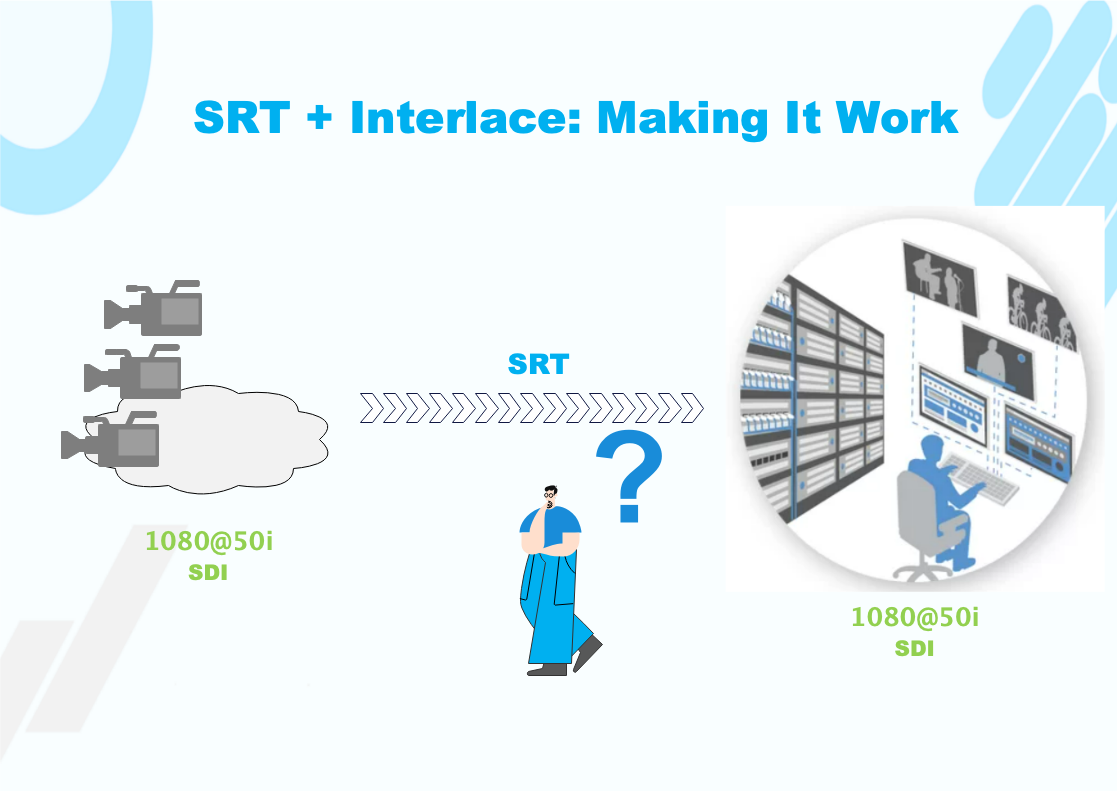
It was precisely television companies that began asking: how can we capture an interlaced signal in one location, transmit it via SRT to another, and output it again in interlaced format via SDI?
To solve this task, our product SRTStreamerPRO has implemented support for the interlaced format.
It was precisely television companies that began asking: how can we capture an interlaced signal in one location, transmit it via SRT to another, and output it again in interlaced format via SDI?
To solve this task, our product SRTStreamerPRO has implemented support for the interlaced format.
However, there are nuances here. After capture, the signal must be encoded, for example, into h264 or HEVC. Our product allows the user to choose the encoding tool: Intel Quick Sync or NVIDIA GPU.
Unfortunately, the interlaced format is not always supported by encoder manufacturers. Careful selection of hardware is essential here.
Unfortunately, the interlaced format is not always supported by encoder manufacturers. Careful selection of hardware is essential here.
Intel Quick Sync (h264 & Interlace)
Intel Quick Sync encoders support interlaced encoding in h264. However, when using discrete ARC-series graphics cards, interlacing is not supported—the content is forcibly converted to progressive. Thus, support is available in integrated GPUs (chips like Core i5, Core i7, i9, some models of the Xeon series) but is absent in discrete ARC cards.
Intel Quick Sync encoders support interlaced encoding in h264. However, when using discrete ARC-series graphics cards, interlacing is not supported—the content is forcibly converted to progressive. Thus, support is available in integrated GPUs (chips like Core i5, Core i7, i9, some models of the Xeon series) but is absent in discrete ARC cards.
NVIDIA GPU (h264 & Interlace)
Support for interlaced encoding in h264 on NVIDIA cards is ambiguous. Cards from the Pascal series and earlier supported interlacing.
But with the introduction of the Turing series of GPUs, NVIDIA ended H.264 interlace support.
When using Turing and newer cards, the content is automatically converted to progressive.
example:
P1000 (Pascal) - Interlace is works for h264.
GeForce RTX 4060 (Ada Lovelace) - NOT supported interlace.
GOOD NEWS: according to recent announcements, NVIDIA has reintroduced support for interlaced encoding in its Blackwell architecture cards. We plan to test this capability in the near future.
Support for interlaced encoding in h264 on NVIDIA cards is ambiguous. Cards from the Pascal series and earlier supported interlacing.
But with the introduction of the Turing series of GPUs, NVIDIA ended H.264 interlace support.
When using Turing and newer cards, the content is automatically converted to progressive.
example:
P1000 (Pascal) - Interlace is works for h264.
GeForce RTX 4060 (Ada Lovelace) - NOT supported interlace.
GOOD NEWS: according to recent announcements, NVIDIA has reintroduced support for interlaced encoding in its Blackwell architecture cards. We plan to test this capability in the near future.
HEVC & AV1
Everything mentioned above concerned the h264 codec. Support for interlacing in new codecs (HEVC and AV1) shows a trend towards completely phasing out this feature. This is unsurprising, given that most screens and content platforms work only with progressive format.
In HEVC, interlaced encoding is still present but in a simplified form. In AV1, there is no support for interlacing at all. Thus, when using HEVC or AV1, difficulties may arise with transmitting interlaced content.
Everything mentioned above concerned the h264 codec. Support for interlacing in new codecs (HEVC and AV1) shows a trend towards completely phasing out this feature. This is unsurprising, given that most screens and content platforms work only with progressive format.
In HEVC, interlaced encoding is still present but in a simplified form. In AV1, there is no support for interlacing at all. Thus, when using HEVC or AV1, difficulties may arise with transmitting interlaced content.
Workaround (for HEVC and AV1)
If it is necessary to use modern codecs (e.g., HEVC) for transmitting interlaced content, a workaround method exists: the 50i stream is converted to 50p, encoded, and transmitted via SRT. On the receiving side, the reverse procedure is performed—converting 50p back to 50i.
This approach allows for efficient transmission of interlaced content using modern codecs and hardware encoding (Intel Quick Sync, NVIDIA).
If it is necessary to use modern codecs (e.g., HEVC) for transmitting interlaced content, a workaround method exists: the 50i stream is converted to 50p, encoded, and transmitted via SRT. On the receiving side, the reverse procedure is performed—converting 50p back to 50i.
This approach allows for efficient transmission of interlaced content using modern codecs and hardware encoding (Intel Quick Sync, NVIDIA).
Conclusion
Utilizing the combination of SRTStreamerPRO and SRTMiniServer provides an effective solution for transmitting interlaced content between locations while maintaining its original quality and format integrity.
Just download and try !
Utilizing the combination of SRTStreamerPRO and SRTMiniServer provides an effective solution for transmitting interlaced content between locations while maintaining its original quality and format integrity.
Just download and try !